
Save our Sea Dragon! Hundreds sign up and back call for council to change its mind and keep huge fossil in the county
By Nub News Reporter 23rd May 2026
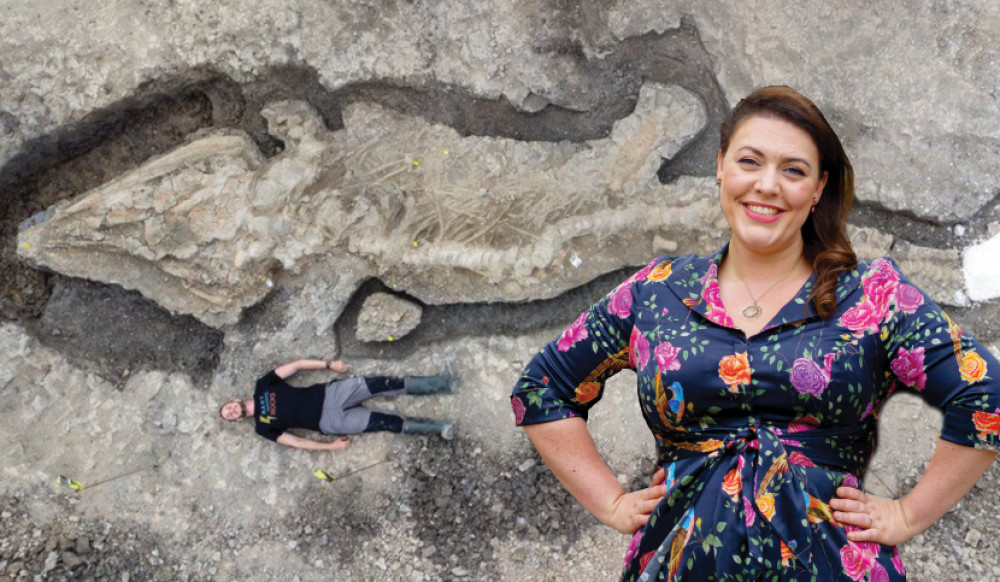

MORE than 1,300 residents have signed a petition to 'Save the Rutland Sea Dragon'.
The fossilised remains of Britain's largest ichthyosaur, colloquially known as a 'Sea Dragon', were discovered in 2021 at Rutland Water Nature Reserve which Leicestershire and Rutland Wildlife Trust manage in partnership with Anglian Water.
It is the biggest and most complete skeleton of its kind found to date in the UK and is also thought to be the first ichthyosaur of its species (called Temnodontosaurus trigonodon) found in the country.
The remains were fully excavated in 2022 and it was hoped to exhibit them at Oakham' museum.
However, Rutland County Council's Cabinet has decided the county cannot afford the project and has voted to abandon negotiations with Anglian Water to acquire the Rutland Sea Dragon for display in the town. Read the council's reasoning behind the decision via this link.
Hoiwever, the decision has prompted local MP Alicia Kearns to launch a petition calling on the council to change its decision.
She says: "The ichthyosaur is a once-in-a-generation find of national importance with the potential to become a major educational, cultural and tourism asset for our county for decades to come. It belongs here, in Rutland.
"Cabinet papers from Rutland County Council report the Council can no longer afford the project, but the financials have not been fully disclosed and the conclusion rests on a Bank of England report published on 30th April, just two working days before a 250 page report was published concluding the project could not go ahead.
Download our Nub News App!
- It’s FREE and available now- Breaking news notifications
- Your Town in Your Pocket


"There are also no financial assessments of the benefits to our county of bringing the Sea Dragon home, and what that would mean for the commercial future of our county museum.
"We believe it could be as little as £300,000 that is needed but we need Rutland Council to be transparent on the costs which were not clear from the Cabinet meeting. We already have Government funds of £2 million to revamp the museum secured in 2023.
"If you believe, like the Friends of Rutland County Museum and Oakham Castle and me, that the Rutland Sea Dragon should come home, we are asking you to sign this petition urging the Council to reverse its decision. If 1,500 Rutland residents sign, the Council will be required to hold a full debate."
The ichthyosaur was discovered by Joe Davis, Rutland Water Conservation Team Leader, during the routine draining of a lagoon island for re-landscaping in February 2021.
Joe and Reserves Officer Paul Trevor set off across the lagoon when Joe noticed what looked like clay pipes sticking up out of the mud, except that "they looked organic."
Joe added: "I worked out on the Hebrides, so I've found whale and dolphin skeletons before. This appeared similar and I remarked to Paul that they looked like vertebrae. We followed what indisputably looked like a spine and Paul discovered something further along that could have been a jawbone. We couldn't quite believe it.
"The find has been absolutely fascinating and a real career highlight, it's great to learn so much from the discovery and to think that this amazing creature was once swimming in seas above us, and now once again Rutland Water is a haven for wetland wildlife albeit on a smaller scale!"
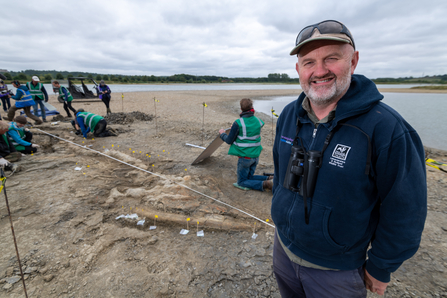

The ichthyosaur is approximately 180 million years old and, with a skeleton measuring around 10 metres in length and a skull weighing approximately one tonne, it is the most complete large ichthyosaur ever found in Britain.
Ichthyosaurs first appeared around 250 million years ago and went extinct 90 million years ago. They were an extraordinary group of marine reptiles that varied in size from 1 to more than 25 metres in length, and resembled dolphins in general body shape.
The fragile remains of the huge skeleton were carefully excavated in August and September 2021 by a team of expert palaeontologists assembled from around the UK, in partnership with Anglian Water, Rutland County Council and Leicestershire and Rutland Wildlife Trust. The excavation was led by world ichthyosaur expert Dr Dean Lomax and specialist palaeontological conservator Nigel Larkin, along with marine reptile specialist Dr Mark Evans, Dr Emma Nicholls from the Horniman Museum and volunteers with experience of excavating fossilised marine reptiles.
Working meticulously, almost a complete skeleton was uncovered. At over ten metres long, this is the biggest and most complete skeleton of its kind found to date in the UK and is also thought to be the first ichthyosaur of its species found in the country.
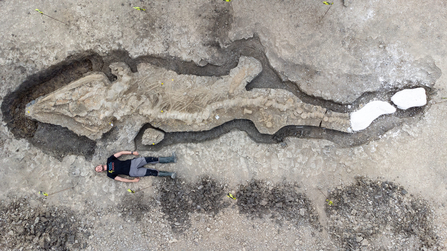
The discovery is not the first at the Anglian Water reservoir, with two incomplete and much smaller ichthyosaurs found during the initial construction of Rutland Water in the 1970s. It is however the first complete skeleton to be discovered there.
CEO for Anglian Water, Peter Simpson said: "Rutland Water has a long list of previous, fascinating archaeological and palaeontological discoveries, but none more exciting than this. We also recognise the significance a find like this will have for the local community in Rutland. Our focus now is to secure the right funding to guarantee it's legacy will last into the future."
In order to preserve the precious remains, Anglian Water is seeking heritage funding. This will also ensure that it can remain in Rutland where its legacy can be shared with the general public.
Dr Dean Lomax, a palaeontologist and a Visiting Scientist affiliated with the University of Manchester, who has studied thousands of ichthyosaurs and named five new species in the process, said: "It was an honour to lead the excavation. Britain is the birthplace of ichthyosaurs – their fossils have been unearthed here for over 200 years, with the first scientific dating back to Mary Anning and her discoveries along the Jurassic Coast. Despite the many ichthyosaur fossils found in Britain, it is remarkable to think that the Rutland ichthyosaur is the largest skeleton ever found in the UK. It is a truly unprecedented discovery and one of the greatest finds in British palaeontological history."

Dr Mark Evans of the British Antarctic Survey and a Visiting Fellow at the University of Leicester said: "I've been studying the Jurassic fossil reptiles of Rutland and Leicestershire for over twenty years. When I first saw the initial exposure of the specimen with Joe Davis I could tell that it was the largest ichthyosaur known from either county.
"However, it was only after our exploratory dig that we realised that it was practically complete to the tip of the tail. Rutland's motto, "Multum in Parvo", translates as "Much in Little" so it is fitting that we've found Britain's largest ichthyosaur skeleton in England's smallest county. It's a highly significant discovery both nationally and internationally but also of huge importance to the people of Rutland and the surrounding area."
Watch a short film about the discovery...
Only a week on from the petition launch, 1,301 residents have signed up.
Ms Kearns said: "It's wonderful to see such a strong show of support in our communities to bring our Sea Dragon home, proving just how much Rutlanders value this extraordinary piece of Rutland's heritage.
"Thank you to everyone who has supported the petition so far – together, we are sending a clear message to the Council that the Rutland Sea Dragon belongs here in Rutland and must be protected for future generations."
The petition is available for e-signing here.
Download our Nub News App:
- It’s FREE and available now
- Breaking news notifications
- Your Town in Your Pocket
Share: